When teams first migrate to cloud Macs, they almost always ask the same question: “How important is the IP address? Can we share an egress?” For pure development work, shared egress may be enough. But the moment e-commerce backends, ad accounts, or cross-border payments enter the picture, the nature of your IP becomes critical — it is not just a network address, it is part of the evidence a platform’s risk-control model uses to decide who you are.
What Is a Physical Native IP
A physical native IP is an address assigned directly to a data center’s physical network interface — not routed through NAT, VPN, or CGNAT before reaching your instance. Native IP ASNs typically belong to the facility operator itself. WHOIS results match the actual egress, and the address is statistically less likely to be flagged as proxy traffic by major platforms.
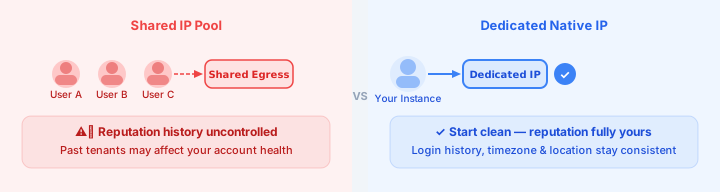
The Core Difference Between Shared and Dedicated
The biggest risk of a shared IP pool is not technical performance — it is “stacked reputation history.” You have no control over what previous tenants of the same IP left behind in e-commerce platforms or ad systems. Once a historical user triggered a ban or fraud flag, new tenants, however compliant their behavior, may be caught in the contaminated IP profile.
The core value of a dedicated IP is the inverse: reputation is written entirely by you from the day you start. Login source is stable, geographic attribution matches your operating timezone, and what the platform sees is a predictable operator — not anonymous traffic bouncing between multiple nodes.
What Platform Risk-Control Systems Look For
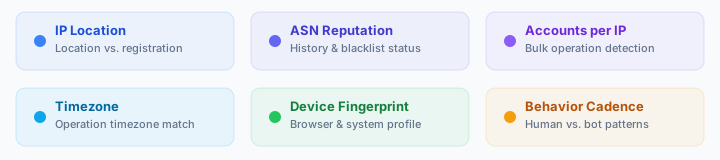
Modern e-commerce and advertising risk-control systems have evolved beyond simple IP verification to multi-dimensional environment fingerprinting. Beyond the IP itself, they factor in: ASN reputation and exposure history, the number of accounts active on the same IP, the timing cadence of operations, and the device fingerprint of the browser and client.
The value of a dedicated native IP is that it keeps all these signals “self-consistent”: only your account is active under that IP, the timezone, language, and registered location align, and the platform perceives genuine business behavior rather than the rhythmic requests of a bulk-operation farm. When every dimension tells the same story, the risk model’s confidence rises and the probability of a false trigger falls.
Practical Recommendations
First, the IP is only one layer of the environment stack — do not rely on it in isolation. Even with a dedicated native IP, if the account’s registered country diverges sharply from the egress location, or a cross-continental double-hop login appears in a very short window, risk-control will still trigger secondary verification. Plan cloud resources on a “one business line, one instance” basis, isolate different platform operations physically, and prevent a single anomaly from cascading to everything.
Second, preserve long-term egress stability. Frequently changing IPs is itself an anomaly signal. Treat a dedicated IP as an accumulating asset, not a consumable — let it build a credible usage history alongside the business. At Hashvps, the egress IP bound to each instance does not change automatically on renewal or plan switch; that is a deliberate product decision.
Third, maintain records. The control panel supports exporting the egress IP’s attributed location, ASN, and change history. When a platform audit requests documentation of your network environment, that record lets you quickly assemble verifiable material. Keeping egress records cross-referenced with billing and operation logs provides stronger evidence during compliance reviews or account appeals.
Summary
Choosing a physical native dedicated IP is not about believing in the magical power of an IP address — it is about eliminating a known risk variable within your control. Truly resilient cross-border operations still require overall alignment of operating habits, account structure, and content quality. At Hashvps we make the networking layer transparent and clearly documented for one reason only: so you can put your energy into the business itself, not spend it repeatedly tracing “which part went wrong.”